The Indus Valley Heritage of Punjab, Sindh, and Gujarat

Artist Visualization of Indus Valley Port
The people of Indus Valley have practiced the act of survival as an art. Its obvious that these people were merchants and traders by profession and not a militarized colony under a sovereign. In my opinion, most researchers have  failed to study the evolution of this business community in that region over last 5000 years. 


Merchants of Indus Valley - artist visualization
The Harrappan people of Indus Valley were engaged in trade with China, Persia, Mesopotamia, and Near East. The Indus cities were connected with rural agricultural communities and distant resource and mining areas through strong trade systems. They used river boats and bullock carts for transport. This trade is reflected in the widespread distribution of exquisite beads and ornaments , metal tools and pottery that were produced by specialized artisans in the major towns and cities.


Jewelry from Indus Valley
Cotton, lumber, grain, livestock and other food stuffs were probably the major commodities of this internal trade. A highly standardized system of weights was used to control trade and also probably for collecting taxes (21 Weights). Excavation also found the oldest dice at Harappa site.


Dice excavated from Harappa
These people were great at technology, architecture and water management systems. The water from Indus river was provided through a network of canals passing through each house. A drain system was used to push the waste to the river from each house. 


Oldest Drainage System - Mohenjo Daro
So who were these people? South Indian Dravidans, Vedic Aryans, Mesopotamians, or descendants of aliens? 


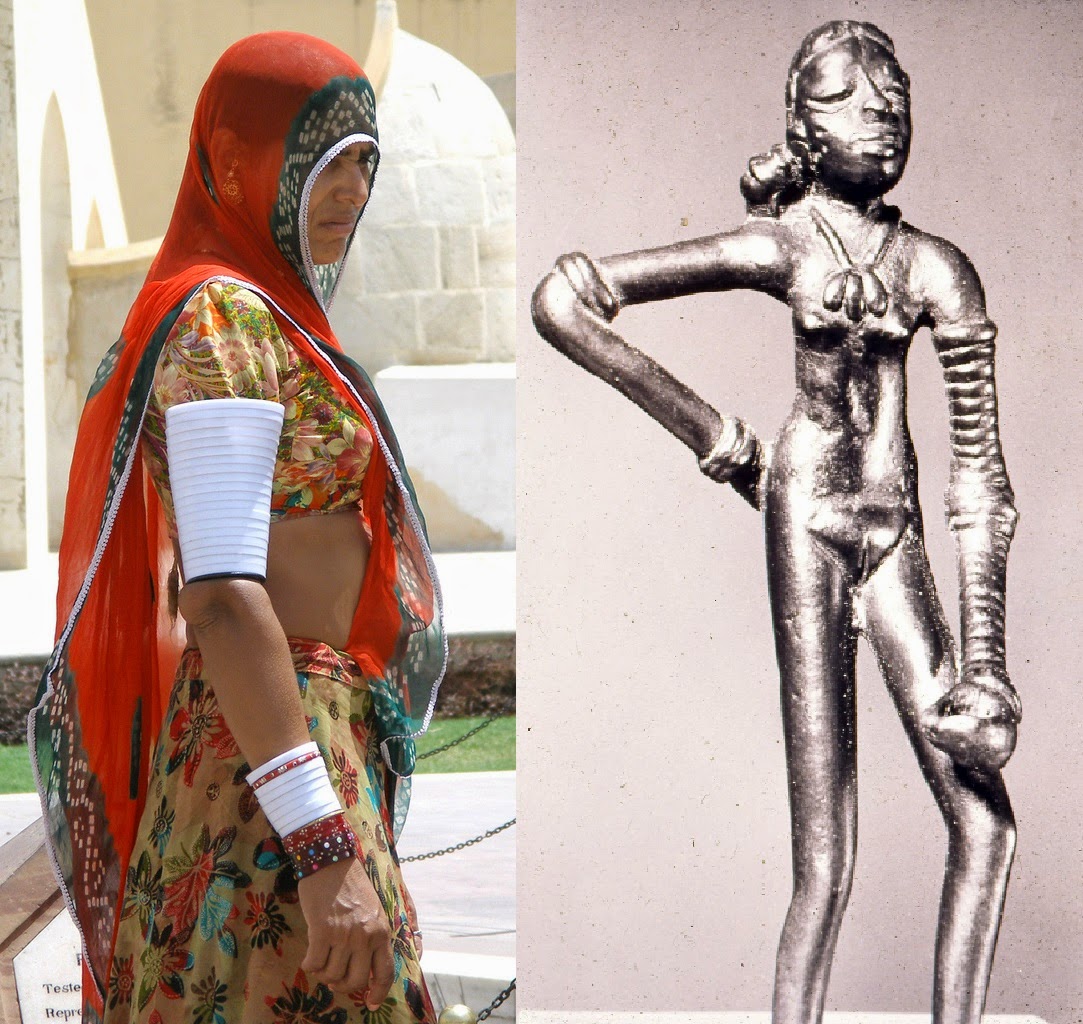
Natives of Indus Valley - Past and Present
The shawl wearing style by Punjabis, and North Indians is still the same as Harappan times. The Harappan girl shows the bangles worn by the girls from Bhatiana and Rajasthan. Even Marwaris from Rajasthan could be associated with this civilization.


Dancing girl from Mohenjo Daro and a Young Lady from North-West India
The Sindhi business families, Punjabi Aroras, and Lohanas from Gujarat are the direct descendants of this illustrious civilization. All of these have similar traits and even common family names. for example, Vohra, Chawla-Chawda, Makhija-Makhijani, Ahuja, Lekhi-Lakhwani-Lakhani, ans so on. These three communities are the original natives of this particular region but historians tend to ignore this fact. The map of Harappan civilizations overlays exactly over the region inhabited by Sindhis, Aroras, and Lohanas.


Locations of Indus Valley Sites in Punjab, Sindh, and Gujarat
Another folly of the historians is that they try to link the current population living around this region and find no substantial genetic link. It is not obvious to the historians that the creation of Pakistan uprooted the original natives from their homeland and dispersed them across India. Now here lies the clue for the historians - this community survived the catastrophe called Pakistanis and reestablished themselves as the leading businesses in India and abroad, the same way this group of people have survived thousands of invasions over time. 

New settlements, and change of power from Vedic Aryan Kshatriyas, Persians, Kushanas, Mongols, Arabs, Turks, Afghans, Mughals, British, and even the Pakistani Islamists have failed to eliminate this community and they flourish even today .. doing what comes natural to them. 
A Minority Sikh Trader from Pakistan

Comments